
Closer Than We Think: Finding the Presence of God in This Chaotic World
An Eastertide reflection for a weary and anxious age.

A few weeks ago, I went to visit one of our church members in a care home here on O‘ahu. I had the address, my phone, and the car’s map app confidently directing me turn by turn. Naturally, I assumed finding the place would be simple. But as I got close, nothing quite lined up. The map insisted I was nearby, yet I could not actually see the house. I drove slowly up and down the street, peering at house numbers and trying to reconcile what my eyes saw with what the glowing blue dot on my map app kept promising. You know that feeling: trusting the technology while suspecting it has betrayed you.
Finally, I pulled into a driveway so I could stop and study the map more carefully. I looked up… and realized I was already there. The care home sat tucked behind another house, nearly invisible from the street. I had pulled directly into the driveway without realizing it. (In fact, the second time I visited, I drove right past it again!)
I was closer than I thought.
I have been thinking about that moment ever since reading the lectionary scriptures for this 6th Sunday of Easter. Because I suspect many of us are living with exactly that feeling spiritually right now: searching for God while unknowingly standing right in the middle of God’s presence.
Living in an Age of Anxiety
It is difficult to overstate how unsettled the world feels at the moment. Every day seems to bring another crisis demanding our attention. Wars expand and mutate. Political divisions harden into mutual contempt. Economic uncertainty lingers in ordinary households. Climate worries grow heavier with each season of fires, storms, droughts, and rising seas. Even our technologies—meant to connect us—often leave us exhausted, angry, or afraid.
Beneath all of that runs a quieter but deeper current: a growing sense of dislocation. People feel untethered. Loneliness is widespread. Institutions are mistrusted. Communities fracture. Families strain under pressure. Many people no longer know where they belong, who they can trust, or what story their lives are part of.
In moments like this, God can seem strangely absent. Not necessarily denied, but distant. We may still pray, still attend church, still hold onto faith in some fashion, yet inwardly wonder: Where is God in all of this? Where is God amid the chaos, the grief, the confusion, and the endless noise?
The ancient world Paul entered in Athens was not so different.
The Altar to an Unknown God
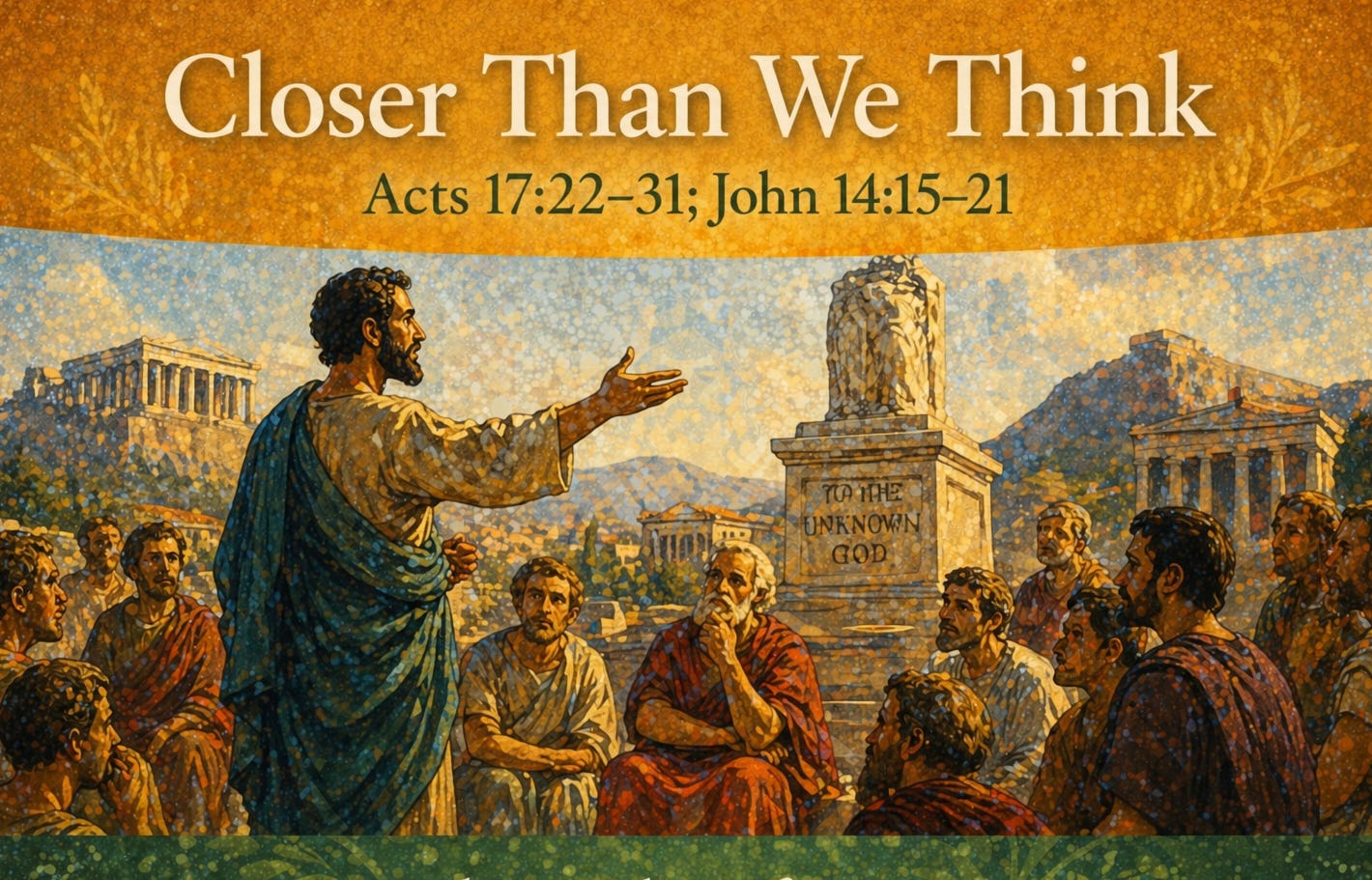
In Acts 17:22-31, the Apostle Paul stands in Athens surrounded by temples, statues, philosophies, and competing visions of reality. It was an intellectually sophisticated city, deeply religious and deeply confused at the same time. Paul notices an altar inscribed: “To an unknown god.” Just in case they had missed one. Just in case there was still some divine reality beyond their systems of understanding.
What is remarkable is how Paul responds. He does not begin with condemnation. He does not mock their confusion or attack their searching. Instead, he begins with recognition: “I see how extremely religious you are in every way.” Then he gently reframes their understanding. The God who made heaven and earth, Paul says, is not confined to temples, shrines, ideologies, or human systems. God is not trapped inside our categories.
Then comes one of the most beautiful lines in all of Scripture: “In him we live and move and have our being.” That is not merely poetic language. It is a complete reorientation of reality. God is not somewhere else. God is not hidden behind the stars waiting to be located by sufficiently enlightened people. God is not absent from the world’s suffering, nor removed from ordinary human life.
God is nearer than we realize, closer than we think.
“I Will Not Leave You Orphaned”
That same theme echoes through John’s Gospel (14:15-21). On the night before his crucifixion, Jesus tells his disciples something astonishing: “I will not leave you orphaned.” Those words land differently depending on our lives. For some people, they sound comforting immediately. For others, they brush against old griefs and complicated memories. Days like Mother’s Day can carry tenderness and gratitude, but also absence, regret, estrangement, or longing.
Jesus speaks directly into that complexity. “I will not leave you orphaned.” Not: I will explain everything. Not: I will remove all suffering. Not even: I will fix the world immediately. But: I will be with you.
The promise of the Holy Spirit is fundamentally a promise of presence. The Spirit abides with us and in us. That matters because many of us imagine God primarily as distant transcendence—a faraway power we occasionally attempt to contact. But the Gospel consistently moves in the opposite direction.
Again and again, Scripture insists that God draws near: near enough to dwell among us, near enough to suffer with us, near enough to inhabit human hearts, near enough that even in our confusion and fear, we are never abandoned.
God in the Middle of the Mess
This does not mean the world is fine. Christian faith is not denial. It is not pretending evil does not exist or that suffering is somehow unreal. The world remains broken in countless ways. Human beings still wound one another. Nations still rage. People still grieve. But Easter faith insists that God is not absent from the mess.
The risen Christ still bears scars. That alone tells us something profound. Resurrection does not erase suffering as though it never happened. Instead, God enters suffering and transforms it from within.
So perhaps the deeper spiritual challenge in our anxious age is not “How do we find God somewhere far away?” but “How do we become attentive to the God already present here?”
God is present in exhausted caregivers, in neighbors helping neighbors after disasters, in quiet acts of generosity no headline will ever notice, in communities that continue gathering for worship, prayer, meals, and service despite all the reasons to give up.
God is present in simple human tenderness and in the stubborn refusal to surrender to hatred. “In him we live and move and have our being.” Especially now.
Paying Attention to Presence
After my visit in the care home that day, I laughed at myself for missing what had been directly in front of me all along. But spiritually speaking, I think many of us do the same thing.
We keep searching frantically for dramatic signs while overlooking the quieter ways grace is already surrounding us. We ask, “Where is God?” while standing in the middle of lives sustained by mercy, friendship, beauty, courage, forgiveness, and love.
We are already parked in God’s driveway.
The invitation of Eastertide is not simply to believe more things about God. It is to awaken to God’s presence already woven through ordinary life. That awakening may begin very simply: paying attention, showing up, praying honestly, caring for one another, loving our neighbor, refusing despair, and continuing to gather around Word and Sacrament even when the world feels unstable. We do these things not because we are escaping reality, but because we are learning to see reality more deeply.
And perhaps that is the great hope of the Gospel in a chaotic age: we are not abandoned, we are not orphaned, and the presence we long for may already be closer than we think.
Ah, Fr. Peter, what you wrote: "Scripture insists that God draws near: near enough to dwell among us, near enough to suffer with us, near enough to inhabit human hearts, near enough that even in our confusion and fear, we are never abandoned."....leads me to think of Perichoresis (which I'm ruminating about right now) and how some of your narrative would make a great homily for Trinity Sunday!
Na'u
H+